What high-performing service organizations change upstream to prevent unnecessary dispatch—and how you can do the same.
Most service organizations invest enormous energy in accelerating response. They optimize dispatch logic, negotiate tighter service level agreements, and track mean time to repair with near religious discipline. What receives far less scrutiny is a more consequential question: how many of those service calls should never have occurred in the first place.
This blind spot is costly. In assetintensive environments, field visits represent one of the largest controllable drivers of service expense, yet they are frequently treated as an unavoidable outcome rather than a preventable failure in upstream decisionmaking.
The data is clear. According to eClerx, only about 60% of scheduled truck rolls ultimately prove necessary, meaning four out of ten field dispatches could have been resolved remotely or avoided entirely through better triage and diagnostics. Each unnecessary visit consumes labor, travel time, and operational bandwidth—long before it shows up as an explicit line item on a P&L.

Why Help Desks Create—or Prevent—Dispatches
Many equipment OEMs and operators run their own help desks because they believe it keeps them closer to customers, gives them more control, and ultimately lowers cost. In theory, that logic holds. In practice, running a high performing help desk at scale requires deep diagnostic expertise, constant process tuning, tight integration with asset data and field operations, and sustained investment in training and analytics. When those capabilities aren’t consistently in place, internal help desks often default to escalation and dispatch—not because a field visit is necessary, but because the system lacks the confidence and context to do anything else. In those cases, maintaining the help desk inhouse doesn’t preserve efficiency or margin; it erodes both.
That’s because most avoidable service calls originate at the help desk, where limited diagnostic authority and fragmented visibility transform uncertainty into dispatch. When service agents lack access to asset history, configuration data, or preventive maintenance insights, escalation becomes the safest option—even if it isn’t the most efficient one.
This pattern is not anecdotal. Gartner has found that organizations integrating service desk operations with asset data and remote diagnostics reduce field dispatch volume by as much as 30%, largely by resolving issues before they reach the point of physical intervention. The implication is straightforward but often ignored: dispatch efficiency is less about technician availability than diagnostic clarity.
In disconnected models, help desks are measured on speed and throughput. In integrated models, they are measured on resolution avoidance.
Preventive Maintenance Solves Problems Long Before They Become Incidents
Avoidable service calls don’t just stem from misdiagnosis; many originate from failures that never should have occurred in the first place. Preventive maintenance, when treated as a strategic input rather than a scheduling obligation, dramatically changes this equation.
Research from the Deloitte Analytics Institute shows that proactive maintenance programs can reduce breakdown frequency by as much as 70% while lowering overall maintenance costs by roughly 25%, specifically by addressing asset degradation before it escalates into failure. Fewer failures naturally translate into fewer emergency calls, fewer reactive dispatches, and more controlled service demand.
The critical distinction is integration. Preventive maintenance only reduces dispatch volume when its insights inform triage decisions and field readiness. When PM data lives in isolation, its value is diluted; when it feeds the help desk and informs dispatch logic, it becomes a powerful mechanism for service avoidance.
The Cost of Measuring the Wrong Thing
Many organizations celebrate faster response times while unwittingly absorbing rising dispatch volume. This is a structural problem, not a performance one.
Field service research consistently shows that 30–50% of routine field visits uncover no actionable issue, particularly in environments where dispatch decisions rely on alarms, customer reports, or incomplete diagnostics. In those cases, response speed is irrelevant; the visit should not have occurred.
When service is designed end to end, success is measured differently. The objective becomes fewer calls, better calls, and field visits that resolve issues decisively when they are truly required.
Three Changes That Reduce Unnecessary Dispatch Today
First, elevate the help desk from call routing to diagnostic authority by integrating asset history, configuration data, and parts visibility into the triage process. Organizations that do this shift from dispatching by precaution to dispatching by probability.
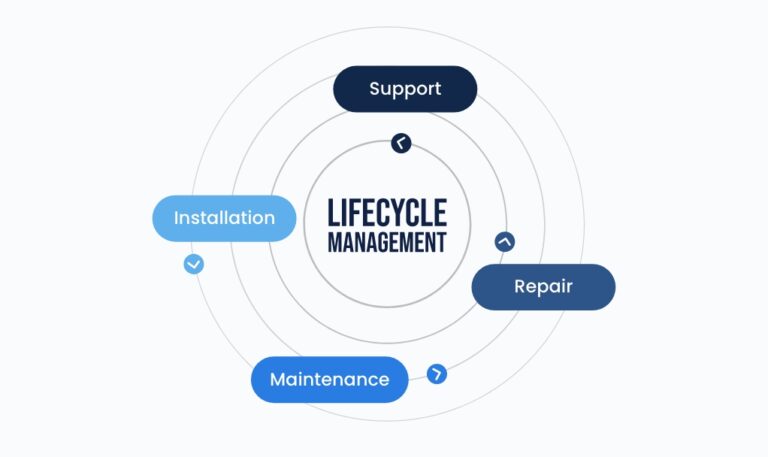
Second, connect preventive maintenance insights directly to triage and scheduling workflows so known failure patterns suppress reactive calls rather than generate them. When preventive signals inform decision making upstream, failures are addressed on planned terms instead of emergency ones.
Third, align field dispatch with parts readiness and repair pathways so that when a visit does occur, it is highly likely to be final. Preparing technicians with the right components and a clear repairandreturn process reduces repeat visits and prevents partial resolution from triggering additional calls.
The most efficient service organizations are not the ones that respond fastest. They are the ones that design service so fewer responses are necessary—and the responses that remain actually work.
That difference starts long before a technician is dispatched.
If you don’t want—or can’t reasonably justify—the cost and complexity of operating a best-in-class service desk, finding the right partner is often the more disciplined choice. The goal isn’t to outsource responsibility; it’s to concentrate it. A partner with the scale, data, and operational maturity to manage triage, preventive insights, and dispatch cohesively can reduce unnecessary service events, improve resolution quality, and free internal teams to focus on growth rather than coordination. In many cases, letting a specialist own this complexity is not a concession—it’s a competitive advantage. Our service model can be yours.
Talk to us today to start designing a better service strategy.