If you’re tired of always fighting fires in the field, it might be time for a more strategic service model.
The easiest way to tell whether a service provider is transactional or truly partnered is to observe what happens between failures, not how quickly they respond once something breaks.
Transactional service providers tend to optimize for the moment of repair. Their value proposition centers on speed, availability, and compliance with narrowly defined service levels. When equipment fails, they react quickly, close the ticket, and move on. Measured in isolation, this can look like strong performance. And it might be exactly what you need.
Partnership driven service organizations work from a fundamentally different premise. Their objective is not simply to fix what broke, but to reduce how often things break at all—and to ensure that when they do, the outcome is predictable, complete, and durable. That difference is not philosophical; it is structural.
Transactions Optimize Speed. Partnerships Optimize Reliability.
In transactional models, service functions are loosely connected. Help desk triage escalates issues without full asset context. Field repair addresses symptoms with limited visibility into prior work or downstream implications. Preventive maintenance is scheduled independently, and parts logistics operate in parallel rather than in concert.
Each function may perform adequately on its own, yet the system remains fragile. Reliability depends on coordination efforts, individual judgment, and informal knowledge rather than intentional design. When something goes wrong more than once, responsibility is often diffused across handoffs instead of addressed as a systemic issue.
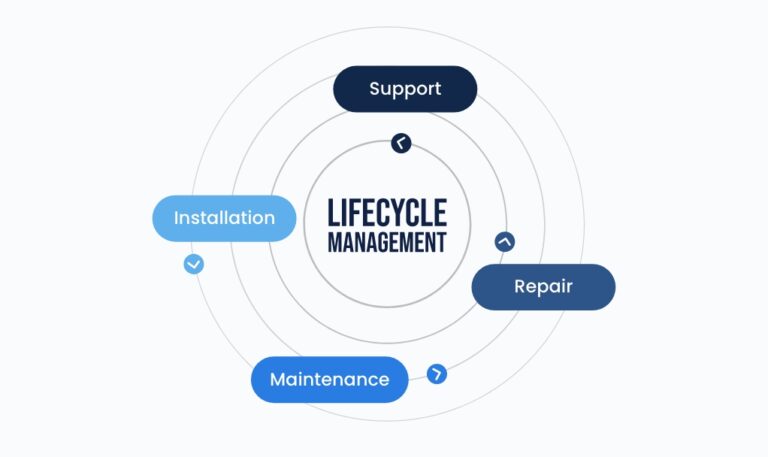
Partnership based service providers design for continuity instead of reaction. Their operating model treats service as a single, continuous flow—from installation through lifecycle management—so that information, accountability, and decision making move together. The benefit isn’t simply faster response; it’s a higher probability that issues are resolved fully and remain resolved.
What Integration Signals About Commitment
Integration is often mistaken for a technical detail when, in reality, it is a behavioral commitment. Providers that invest in integrating help desk operations, preventive maintenance, field service, parts management, and depot repair are signaling something important: they expect to be accountable for outcomes over time, not just performance in the moment of intervention.
That accountability changes how service is delivered. Technicians don’t arrive blind; they arrive informed. Dispatch decisions are influenced by asset history, known failure patterns, and parts readiness rather than urgency alone. Recurring issues trigger root cause analysis instead of repeat tickets.
In transactional relationships, the cost of misdiagnosis or partial repair is absorbed downstream by the customer in the form of additional calls, extended downtime, and internal coordination. In partnership relationships, those costs remain internal to the service organization, creating a natural incentive to fix problems structurally rather than repeatedly.
Uptime Is Built When Accountability Is Undeniable
One of the clearest distinctions between transactional and partnershiporiented providers is how they handle recurrence. In fragmented models, repeat failures produce defensiveness: triage points to the field, field points to parts, parts point elsewhere. Each function can reasonably claim local compliance while the overall experience deteriorates.
True partners cannot hide behind functional boundaries. When service is integrated, accountability for uptime is explicit and unavoidable. Failures—especially recurring ones—are treated as signals that the system needs adjustment, not merely another response. Over time, this creates a learning loop in which service activity actively improves future performance.
This is where partnership becomes tangible. A provider who owns reliability must care about why failures occur, not just how quickly they can be addressed once they do.
Why Transactional Models Struggle to Scale
Transactional service scales volume more easily than outcomes. As asset counts grow and coverage expands, coordination costs rise disproportionately. More vendors, more handoffs, more exceptions, more dependence on institutional memory. Performance variability increases even when individual KPIs remain stable.
Partnership based providers scale differently. Because workflows, training, and accountability are aligned, growth increases demand without increasing ambiguity. New locations inherit established service behavior. New technicians are trained into consistent standards. Customers experience continuity instead of regional variation.
This is why organizations that depend on uptime eventually outgrow transactional service models—not because speed stops mattering, but because reliability cannot be improvised at scale.
The Question That Matters
Fast fixes are valuable. Responsive technicians are necessary. SLAs still matter.
But the real question is whether your service provider is optimized to close tickets—or to protect uptime.
Transactional providers deliver answers to incidents. Partnerships deliver confidence over time. The difference shows up not in how quickly your phone is answered, but in how rarely you need to make the call at all.
If you’re currently assessing service providers and not sure where to start, check out our Definitive Guide to Evaluating Future Service Partners for a great set of questions to ask.